



- Ajay Sharma
-
 SEO
SEO
How does Entity Authority Work in AI Driven Search Engine Optimization?
Search is no longer about getting ranked on top SERPs. Nowadays it’s more inclined toward whether bots and machines can comprehend, trust, and repurpose what the user publishes. In AI driven search engine optimization, online presence relies less on surface touchpoints and more on how understandable your content is and how clearly it can be applied to users’ queries.
In Google AI Overviews and several LLMs, being ‘credible’ only to users is not sufficient. Your content should be structured, reinforced, and easy for machines to reuse without second guessing. If it is unable to achieve that, it simply gets ignored no matter how trustworthy your brand looks to end users.
Although SEO services emphasize rankings, mentions, and impressions, AI driven search engine optimization prioritizes usefulness. If your authority can’t be retrieved, confirmed, and extracted within a structured context, it will hardly impact what users see.
In this blog, let’s explore how entity authority works in AI driven search engine optimization. We’ll also talk about how traditional SEO strategies often fall short and how to build entity strength that boosts online presence in advanced search results.
Why Traditional SEO Authority Signals Fall Short
For many years, even the best SEO services out there operated on a pretty simple concept – follow E-E-A-T and it would make your website authoritative. So we focused on optimizing author bios, credentials, About Us pages, and outbound links.
In reality, we knew what really made the difference. Inbound Links.
E-E-A-T never really replaced external validation but structured it. While E-E-A-T helped sites look clean and organized, it was inbound links and third party mentions that brought SEO authority. This setup worked fine as long as authority didn’t need to be machine specific or entity level precise.
The real problem arises when search systems actually need to use entity authority for retrieval and citation, and not just acknowledge it. Being labeled as ‘authoritative’ is not enough in AI driven search engine optimization. Authority must be specific, machine-readable, and supported by multiple sources, or it won’t be used.
How Entity Authority is Calculated in AI Driven Search Engine Optimization
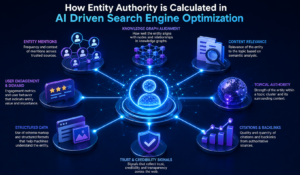
Search no longer works as it used to. It doesn’t run on a flat plane of keywords. Modern AI-led systems rely on a multi-layered semantic space that maps topics, entities, relationships, and topical proximity. That’s why the best SEO services today focus more on structure and logic than on surface level optimization.
Inside this semantic space, entities act like objects. Each object has an impact, but that impact depends on its connection with everything around it. E-E-A-T still matters but the framework version doesn’t give you an edge. Now, you can evaluate authority in a broader context that can’t be optimized with a few on page tweaks.
In LLMs, Visibility doesn’t hinge on prestige or brand name alone. Instead, it relies on whether AI systems recognize your entity as authoritative within a topic cluster. Those come from authority and not because the system trusts or uses you. What actually matters here is whether the system can locate your entity within its semantic space and whether that entity holds enough weight to exert influence.
This weight isn’t ornamental. It has come from third-party mentions and citations, and has been made easy for systems to understand through consistent authorship, structure, and clear relationships. AI machines don’t trust brands emotionally. They assess entity authority through measurable signals across sources.
That’s why smaller brands don’t need to shine like those that have been dominating search for years. Size and visibility don’t determine authority. Density does!
The E-E-A-T Score Misconception
E-E-A-T was never the issue. The real problem was the way website owners used it. They used E-E-A-T score to ensure sites look trustworthy through signals they controlled themselves. They optimized Author bios, credentials, About Us pages, and added outbound links to make their brand sound credible on the surface, but didn’t change how entity authority was actually established across the web.
This strategy held when search systems were willing to infer trust through proxies. It eventually failed in AI driven search engine optimization, where authority must be explicitly reinforced, extracted, and machine-readable to carry weight.
These surface-level trust markers don’t fall flat because systems ignore them. They fail because they don’t carry adequate weight to give an entity real mass. In human-focused search, these trust markers were reasonable shortcuts. However, in AI driven search engine optimization, they don’t translate the same way. Systems don’t evaluate intent or presentation. They assess semantic consistency, entity alignment, and whether claims can be double checked across other sources.
Therefore, it’s safe to say, the E-E-A-T score isn’t outdated. It’s incomplete. It explains why a person might rely on you and not why a machine would. Applying E-E-A-T only to your website won’t create the strength required for AI systems to trust, prioritize, or reuse your entity.
How to Build Entity Strength that Enhances Visibility
Conventional SEO methods focused on brand reputation and backlinks. Those signals still matter but modern SEO practices like Gemini SEO and Chat GPT SEO desire entity strength for discovery. This means your content must be easy for machines to use.
Consider two websites, both featuring recognized experts –
- One uses simple headings, clear definitions, and consistent links to verified profiles.
- The second buries the same expertise inside complex, unstructured paragraphs.
Only one of them will earn citations or show up in AI results
Large Language Models work best when information is clean and specific. They rely on:
- One entity per paragraph or section
- Explicit, unambiguous mentions
- Repetition that reinforces relationships (“Mr. John Doe, Psychiatrist at ABC Hospital”)
In AI driven search engine optimization, entity strength is built by making authority easy to extract through structure, repetition, and unambiguous entity references.
Final Thoughts
AI driven search engine optimization has changed the rules, but not in the way most people think. Entity authority in search systems hasn’t disappeared. It’s just no longer established through backlinks, credentials, or on-page trust markers alone. Machines don’t respond to emotions or promises. They respond to clarity, consistency, and reinforcement.
If your expertise can’t be identified, verified, or reused without interpretation, it doesn’t matter how genuine or trustworthy you look on the surface. In advanced search systems, authority only counts when it can be extracted and applied.
That’s why modern SEO isn’t about chasing rankings anymore. It’s about building entity strength that machines can recognize, trust, and connect to. Structure, semantic alignment, and external validation are no longer supporting tactics. They’re the foundation. For businesses trying to stay visible, adapting to this emerging trend is mandatory.
If you’re looking to opt for AI SEO services or want guidance from an experienced SEO Company in Florida, reach out to Ennoble Infotech. We help brands build entity authority that machines can understand and verify where it matters most.

 April 2, 2026